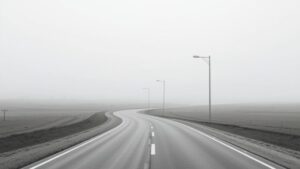
After illness, many people try to return to a familiar path.
A steady recovery.
A gradual improvement.
A life that moves forward in a straight line again.
But what if that line never returns?
What if progress is no longer predictable, measurable, or even visible in the way it used to be?
This is not only a physical problem.
It is a structural one.
This article explores how life can be redesigned when linear progress is no longer a reliable assumption.
The Assumption We Rarely Question
Before illness, progress feels almost self-evident.
Effort leads to results.
Time leads to improvement.
Consistency leads to accumulation.
This is not something we actively choose to believe.
It is embedded in how most systems around us are designed.
Education rewards steady advancement.
Careers are built on upward movement.
Even personal growth is framed as continuous development.
Because of this, we begin to organize our lives around a simple expectation:
That progress is linear.
Why Linear Progress Feels “Natural”
Linear progress feels natural not because it is universally true,
but because it is widely reinforced.
We are surrounded by timelines, milestones, and benchmarks.
There is always a “next step.”
There is always a measurable direction.
This creates a sense of clarity.
You know where you are.
You know where you are going.
And you know how to evaluate yourself along the way.
But this clarity depends on one condition:
That the line continues.
When Progress Stops Looking Like Progress
After illness, that condition begins to break.
Effort no longer guarantees improvement.
Rest does not always restore capacity.
Time does not necessarily move things forward.
Some days feel manageable.
Others feel like a complete reset.
From the outside, it may still look like recovery.
But from the inside, it feels discontinuous.
The Difficulty of Recognizing Non-Linear Change
When progress is no longer linear,
it becomes harder to recognize.
There is no clear accumulation.
No consistent trajectory.
Improvements may appear, then disappear.
Stability may last briefly, then collapse.
Because of this, something subtle happens.
You begin to question whether progress is happening at all.
Not because nothing is changing,
but because the change does not fit the expected pattern.
The Quiet Pressure to Return to a Straight Line
Even when your experience changes,
the framework around you often remains the same.
Recovery is expected to be gradual.
Improvement is expected to be visible.
Time is expected to “fix things.”
There is a quiet pressure to return to that model.
To get back on track.
To regain previous pace.
To rebuild what existed before.
When the Model Becomes the Problem
This pressure is not always explicit.
It can come from others.
Or from your own internal standards.
But its effect is the same.
If you continue to measure your life using a linear model,
anything that does not fit that model starts to feel like failure.
Even if, in reality, you are adapting.
Even if, structurally, you are functioning differently.
The model does not recognize that difference.
Redefining Progress as Stability, Not Growth
At some point, a different definition becomes necessary.
Progress may no longer mean moving forward.
It may mean maintaining.
Holding a baseline.
Avoiding collapse.
Sustaining what is still possible.
Why Stability Is Often Invisible
This kind of progress is difficult to see.
It does not produce visible milestones.
It does not accumulate in obvious ways.
From the outside, it may look like nothing is happening.
But internally, it requires continuous adjustment.
Energy must be managed.
Limits must be respected.
Decisions must be recalibrated.
Stability, in this context, is not passive.
It is an active form of maintenance.
Designing Around Variability Instead of Fighting It
When capacity becomes unpredictable,
consistency can no longer be assumed.
Trying to force stability often leads to breakdown.
Instead, life must be designed around variability.
Some days allow more.
Others require less.
This is not a temporary phase.
It becomes a structural condition.
From Control to Absorption
Before illness, design often focuses on control.
You create systems to optimize output.
You build routines to reduce uncertainty.
After illness, the objective changes.
You are no longer trying to eliminate variability.
You are trying to absorb it.
Schedules become flexible.
Plans become provisional.
Expectations become adjustable.
The goal is not to maintain a fixed pace,
but to continue without breaking.
Letting Go of Cumulative Identity
Linear progress is closely tied to identity.
Who you are is often defined by what you have accumulated.
Skills.
Achievements.
Experiences.
When progress becomes non-linear,
this accumulation becomes uneven.
Identity Without Accumulation
This creates a subtle tension.
If you are not continuously building,
are you still moving forward?
If your output fluctuates,
what defines you?
At some point, identity must shift.
Instead of being cumulative,
it becomes adaptive.
The question changes.
Not “What have I built?”
but “What can I sustain?”
A Life That Moves Differently
A non-linear life is not directionless.
It still moves.
But not in a straight line.
It expands and contracts.
It pauses and resumes.
It adjusts constantly.
Continuity Without Acceleration
There is still movement.
But it is not always visible as progress.
There are no clear upward trends.
No steady accumulation.
Instead, there is continuity.
Something is being maintained.
Something is being held.
Over time, this creates a different kind of structure.
Not one based on acceleration,
but one based on endurance of form.
What Remains When the Line Disappears
When the expectation of linear progress fades,
something quieter takes its place.
Decisions become less about optimization,
and more about sustainability.
Value shifts.
From speed to durability.
From expansion to continuation.
A Different Way to Measure Life
Life is no longer measured by how far it moves.
It is measured by how well it holds.
Can it continue without collapse?
Can it adapt without breaking?
Can it sustain itself over time?
This is not a lesser form of progress.
It is simply one that does not rely on a straight line.
🔗Related Articles